• Skip to primary navigation
  • Skip to main content
  • Skip to primary sidebar

Thomas More Law Center

The Sword and Shield for People of Faith

  • Home
  • Key Issues
    • Defending the Religious Freedom of Christians
    • Restoring Family Values
    • Defending the Sanctity of Human Life
    • Confronting the Threat of Radical Islam
    • Defending National Security
  • News
    • Press Releases
    • TMLC News Alerts
  • About
    • About the Thomas More Law Center
    • President & Chief Counsel
    • History of the Law Center
  • Contact
    • Contact
    • Request for Legal Help
  • Donate
    • Become a TMLC Member
    • Other Ways to Give
      • Planned Giving
    • Financial Transparency Information

thomas more

Supreme Court Will Consider Whether A 40-Foot Cross Must Be Removed To Appease Atheists And Dishonor Fallen WWI Soldiers

February 26, 2019 by TMLC

  February 26, 2019 

   ANN ARBOR, MI – On Wednesday, February 27, the U.S. Supreme Court will hear oral arguments on whether to reverse the U.S. Court of Appeals for the Fourth Circuit decision which ordered the removal or disfigurement of a 40-foot tall cross erected in 1925 to memorialize the World War I service and death of forty-nine soldiers from Prince George County, Maryland.  
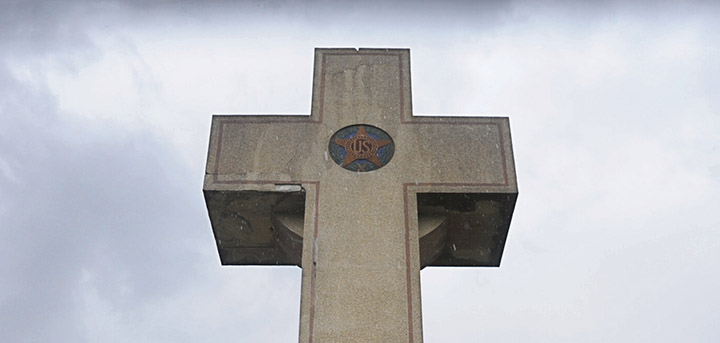
   The “Peace Cross of Bladensburg” located at the entrance to the town of Bladensburg, Maryland sits on a rectangular base which includes the words “Valor,” “Endurance,” “Courage,” and “Devotion.” A bronze plaque lists the names of the forty-nine fallen sons of Bladensburg. Above the names is the inscription: “This Memorial Cross Dedicated To The Heroes of Prince George’s County Maryland Who Lost Their Lives In The Great War For The Liberty Of The World.”

   The Fourth Circuit ruled that the cross is the “preeminent symbol of Christianity,” and that while the cross may generally serve as a symbol of death and memorialization, it only holds that value because of its affiliation with the crucifixion of Jesus Christ, and thus violates the Establishment Clause of the First Amendment.

   The Thomas More Law Center (“TMLC”), a national public interest law firm based in Ann Arbor, Michigan, engaged in the heated culture war battle over the meaning of the Establishment Clause, by filing an amicus brief (friend of the court brief) to save the Cross. The stakes are high.   Crosses throughout the nation, including those in the Arlington National Cemetery, will be in jeopardy should the Supreme Court affirm the lower court decision.     

   This is the second amicus brief filed by TMLC. The first brief, filed in July 2018, asked the Supreme Court to review the Fourth Circuit’s ruling against the cross. Once the Supreme Court agreed to review the ruling, this second brief, filed on December 19, 2018, asks the Supreme Court to reverse the Fourth Circuit’s decision.
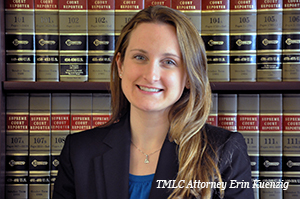
   The federal lawsuit challenging the “peace cross” was brought in 2014 by three atheists who occasionally drove past the cross and claimed they were offended. TMLC’s brief authored by Erin Kuenzig addresses their claim by arguing,

“Allowing a historic war memorial to be destroyed to quell some momentary discomfort plaintiffs feel when they drive past the Bladensburg monument would do real and lasting harm to this country; it would send a message of disrespect to our fallen soldiers and their families, and it would deprive future generations of a treasured piece of history.”

   TMLC’s brief also claims that the Fourth Circuit Court of Appeals decision shows a hostility toward religion, particularly Christianity, not intended by the Constitution. 

   Moreover, TMLC’s brief importantly points out,

“We cannot change the stories of the dead to appease the all too easily offended living. Any harm respondents feel they incur due to seeing the shape of a cross when they happen to drive past the Bladensburg memorial, pales in comparison to the real and lasting harm that destroying such memorials will cause to this country as a whole, to veterans’ families, and to the memories of the men and women who are honored by them.”

   Clearly, use of the Latin Cross in 1925 reflected the custom in Europe during World War I where the cross became the principal grave marker in cemeteries where soldiers were buried as described in the opening lines “In Flanders Fields,” a famous poem of the time whose opening line begins “In Flanders fields the poppies blow, between the crosses, row on row.”

   In this case, the purpose of the cross is to honor the dead using a historical symbol of death and sacrifice. The decision to destroy this memorial, simply because the plaintiffs claim to be offended by the memorial’s Latin cross, evidences an intolerance to Christianity that is wholly inconsistent with our nation’s history and with the purpose and meaning of the First Amendment’s Establishment Clause.

   Click here to read TMLC’s brief filed on December 19, 2018.

   Click here to read TMLC’s first brief.
 

Filed Under: News Alert Tagged With: bladensburg, establishment clause, first amendment, religious freedom, SCOTUS, thomas more, TMLC

Saint Thomas More – A Model of Christian Discipleship Today

June 22, 2018 by TMLC

“If we lived in a state where virtue was profitable, common sense would make us saintly. But since we see that avarice, anger, pride and stupidity commonly profit far beyond charity, modesty, justice and thought, perhaps we must stand fast a little, even at the risk of being heroes.” – Thomas More

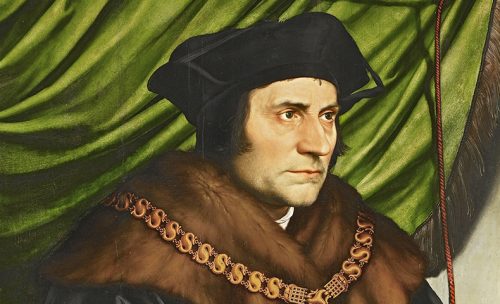
   Today, June 22, the feast day of Saint Thomas More, is especially important to the Thomas More Law Center, as he is the namesake of our organization and in many ways, exemplifies the mission and ideals to which we aspire in our daily work as a public interest law firm.

   We remember More as a man devoted to Christ who willingly sacrificed his power, his wealth, and ultimately his life out of love for Christ and His Church.

   The subject of the 1966, Academy award-winning film, “A Man for All Seasons,” Thomas More is recognized as one of history’s most admired figures. An outstanding lawyer, author, judge and diplomat, he rose to the highest office in England next to the King. Yet he chose death rather than betray his conscience. More was beheaded on July 6, 1535 on orders of King Henry VIII, his one-time friend, because he would not accede to the Oath of Supremacy declaring Henry to be the supreme head of the Church of England.  

   As he stood on the scaffold before his execution, he proclaimed to the crowd “I die the King’s good servant, but God’s first.” In that simple phrase More summarizes the call of Christian discipleship and the proper perspective we must all bring to our daily lives and work – to be God’s servant first!

   On Thomas More, Winston Churchill wrote: 

“He represents to history its universality, its belief in spiritual values, and its instinctive sense of otherworldliness.” 

   Pope John Paul II commenting on the life of Thomas More, wrote:

“What enlightened his conscience was the sense that man cannot be sundered from God, nor politics from morality.

And it was precisely in defense of the rights of conscience that the example of Thomas More shone brightly. It can be said that he demonstrated in a singular way the value of a moral conscience which is ‘the witness of God himself, whose voice and judgment penetrate the depths of man’s soul’ even if, in his actions against heretics, he reflected the limits of the culture of his time.”

   So, has that much really changed?

   Liberals want to confine a Christian’s religious freedom to a matter of belief rather than expression and action. In other words, you can think whatever you want, just keep it within the confines of your brain.

   But we define ourselves by our actions.  We are citizens of both the earthly and heavenly cities, and so, will act in accordance with realities of both on issues such as marriage, abortion, the sanctity of human life, euthanasia, what is taught to children in public schools, and the list goes on.

   It takes moral courage to say “no” to those in power. The Thomas More Law Center has represented many modern-day Thomas Mores in the 20 years of our existence. And that number is increasing.

   Indeed, there are courageous men and women in our culture today. They will not be beheaded for their moral and religious based actions, but they are more likely to be bankrupted by punitive civil penalties, ostracized from their profession and even their churches (Thomas More was highly critical of the Bishops of his day), ridiculed by the media and culture elite and even their neighbors, fired from their jobs, frozen out of certain occupations and professions.

   Like Thomas More, they will be condemned as “criminals” who defy the general order because of their religious consciences. They will be told, “You can keep your consciences to yourself as long as you do what society and the government demands.”

   In 1929, the renowned author, G. K. Chesterton, wrote: 

“Thomas More is more important at this moment than at any moment since his death . . .but he is not quite so important as he will be in about a hundred years’ time.”

   Although it hasn’t quite been a hundred years, Chesterton’s prediction is already proving true. In an increasingly powerful and militant secular culture that exhibits its growing hostility towards Christians, Thomas More provides the model for all faithful followers of Christ— regardless of denomination.  

   In his life and death, Thomas More summarizes the call of Christian discipleship and the proper perspective we must all bring to our daily lives and work – to be God’s servant first!

Filed Under: Blog Tagged With: feast day, law, thomas more

Primary Sidebar

  • The President’s Blog
  • TMLC in the News
  • Request for Legal Help
  • Leave a Legacy
  • Sign up as Pro Bono Attorney

Get Email Updates

STAY CONNECTED
  • Become a Fan
  • Follow Us
  • Video Library
  • RSS Feed

  • Home
  • Key Issues
  • News
  • About
  • Contact
  • Donate
© 2024 - Thomas More Law Center • 24 Frank Lloyd Wright Drive • Suite J 3200 • Ann Arbor, MI 48106 • Office: 734.827.2001 • Fax: 734.930.7160